 Go to content


Play Expertise
THE APPEAL OF WATER PLAY
Water features add sensory richness and interactive possibilities that complement climbing and movement equipment. Children's fascination with water is universal and enduring - water play engages users across age ranges, abilities and interests in ways that few other playground elements can match.
For designers and developers, water play integration represents strategic investment. Well-designed water features create distinctive character, extend dwell time and provide memorable experiences that draw repeat visits. They also offer valuable inclusive play opportunities, accommodating children with varied physical capabilities alongside typically developing peers.
BENEFITS OF WATER PLAY
The case for incorporating water features into adventurous playgrounds rests on multiple developmental, experiential and practical considerations.
Sensory Development and Exploration
Water provides uniquely rich sensory experiences. Its fluidity, temperature variation, reflective qualities and sound engage multiple senses simultaneously. Children explore water's properties through direct manipulation - pouring, splashing, channelling and damming - developing understanding of physical concepts through embodied learning.
The sensory stimulation proves particularly valuable for children with sensory processing differences. Water play offers opportunities for sensory regulation - calming for some children, alerting for others - in naturalistic contexts. The predictable yet varied nature of water flow provides sensory feedback that supports body awareness and motor planning.
Temperature variation adds another sensory dimension. In British climates, water features typically operate at ambient temperature, creating cooling opportunities during warm weather whilst remaining comfortable in moderate conditions. This temperature variation provides thermoceptive input that enriches sensory experiences.
Cognitive Growth and Scientific Learning
Water play creates natural contexts for exploring scientific and mathematical concepts. Children observe cause and effect as they pump water and watch it flow. They experiment with volume and capacity through filling containers. They discover principles of hydraulics, gravity and fluid dynamics through direct manipulation of channels, mills and pumps.
These explorations occur through play rather than formal instruction, making scientific principles accessible and engaging. A child engineering a complex channel system to direct water flow engages in sophisticated problem-solving, hypothesis testing and iterative refinement - all fundamental scientific processes.
Social Skills and Collaborative Play
Water play naturally encourages social interaction and cooperation. Pumping systems often require coordination between children. Channel systems can be collectively engineered, with multiple children contributing to shared goals. Water's abundance allows multiple children to engage simultaneously without competition for limited resources.
The collaborative nature of water play supports peer learning and communication development. Children negotiate roles, share discoveries and solve problems collectively. Older children model techniques for younger ones, creating multi-age learning opportunities that rarely occur with more competitive playground activities.
Water play also provides neutral ground for children who might struggle with more physical playground activities. Children with limited climbing ability or mobility challenges can fully participate in water play, creating inclusive opportunities where all children contribute equally.
Physical Coordination and Motor Development
Whilst less obviously physical than climbing or swinging, water play develops important motor skills. Operating pumps requires coordinated arm movements and rhythmic motion. Pouring and channelling water develops hand-eye coordination and fine motor precision. Positioning dams and adjusting flows requires spatial planning and manual dexterity.
The physical demands remain manageable for most users whilst still providing skill development opportunities. This makes water play particularly valuable for younger children developing foundational motor skills or children with physical disabilities who benefit from low-impact movement activities.
POPULAR WATER PLAY FEATURES AND EQUIPMENT
Several water play elements have proven consistently successful in adventure play spaces, each offering distinct interactive possibilities and developmental benefits.
Hand Pumps and Mechanical Water Systems
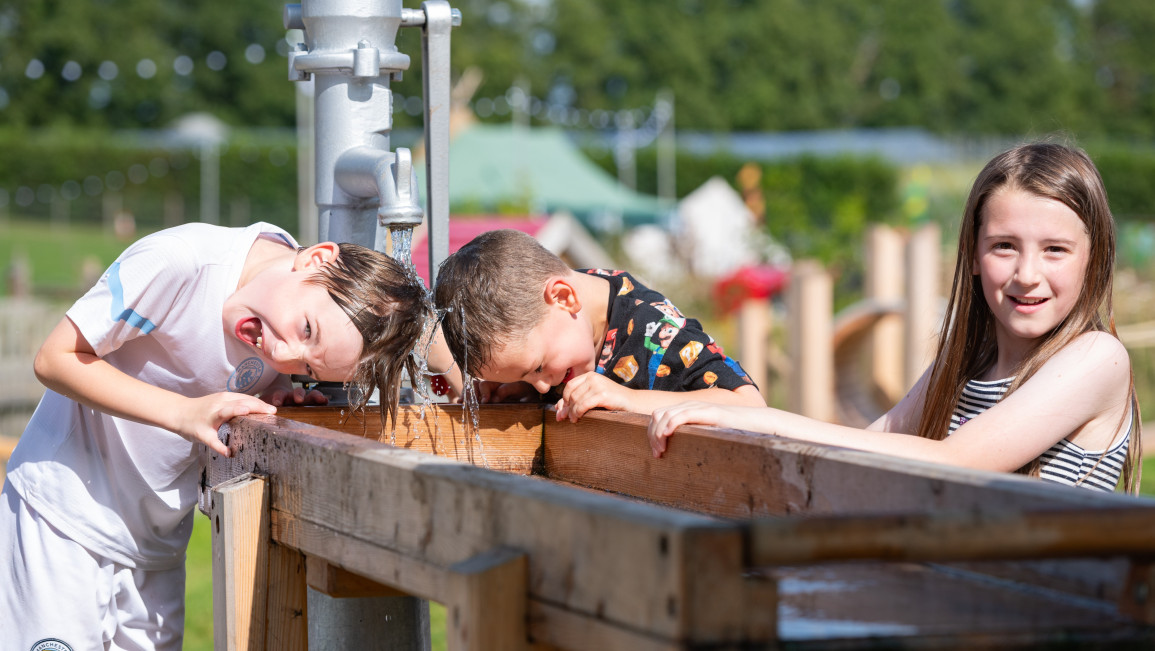
Hand pumps form the cornerstone of most playground water features, providing clear cause-and-effect relationships that appeal across age ranges. Children as young as three can operate straightforward pump designs, whilst older children enjoy the physical challenge of maintaining pumping rhythms or coordinating with partners.
Modern pump designs incorporate robust construction suitable for intensive playground use. Stainless steel mechanisms resist corrosion whilst providing smooth operation. Ground-mounted installations prove most durable, with pump housings set in concrete foundations and above-ground components designed for easy maintenance access.
Pumps connect to channel systems, creating extended play sequences where pumping generates flows that children then manipulate and direct. The most successful installations provide sufficient flow rate to feel rewarding - weak trickles frustrate users - whilst remaining manageable within water supply and drainage infrastructure.
Water Channels, Dams and Diversion Features
Channel systems transform pumped water into extended play opportunities. Children position dams to create pools, adjust flows to power water wheels, and engineer routes to achieve specific outcomes. These open-ended systems support sustained, absorbing play as children experiment with different configurations.
Effective channel design balances structure with flexibility. Fixed channels provide reliable water routes and ensure proper drainage, whilst moveable elements (repositionable dams, adjustable gates, removable plugs) allow children to modify flows and create varied effects.
Material selection influences both functionality and aesthetics. Stainless steel channels provide durability and hygienic surfaces but can become uncomfortably hot in direct sun.
Timber channels offer pleasant tactile qualities and moderate temperature but require careful detailing to prevent leaking and ensure longevity. Moulded plastic channels prove economical and functional but lack the aesthetic quality of natural materials.
Water Mills and Wheels
Water wheels and mills demonstrate mechanical principles whilst providing visual interest and satisfying spinning motion. Children enjoy the immediate feedback of water setting wheels in motion, and more thoughtful users experiment with flow rates and positioning to maximise wheel speed.
These features work well as focal points within water play zones, creating visual activity that attracts users and signals play possibilities. Their mechanical action also appeals to children interested in how things work, supporting STEM learning through play.
Installation requires careful attention to bearing quality and mounting security. Wheels must rotate freely under light flows whilst remaining secure under enthusiastic manipulation. Sealed bearings prevent water ingress and extend service life.
Water Tables and Basin Systems
Water tables provide contained play areas particularly suitable for younger children or settings requiring more controlled water distribution. Raised tables accommodate wheelchair users and reduce bending for adults supervising. Recessed basin systems create ground-level play zones that integrate with surrounding surfacing.
Tables typically incorporate multiple basins at varied heights, accommodating different user needs and providing distinct play zones within compact footprints. Drain plugs allow periodic emptying for cleaning, and overflow provisions prevent water accumulating beyond designed depths.
Basin systems prove valuable where extensive drainage infrastructure isn't feasible. The contained nature limits water distribution whilst still providing satisfying play experiences. They also suit settings where water must be turned off frequently, as basins dry quickly without leaving extensive wet surfaces.
Spray and Splash Features
Interactive spray features add dynamic, theatrical water experiences. Trigger-operated sprays, timed jets and spray arcs create cooling, exhilarating moments that particularly appeal during warm weather. These features complement manipulative water play equipment, offering contrasting experiences within unified water zones.
Design considerations include spray patterns that minimise water waste whilst maximising play value, durable activation mechanisms that tolerate enthusiastic use, and appropriate water pressures that create satisfying effects without becoming uncomfortable or potentially harmful.
DESIGN PRINCIPLES FOR WATER PLAY INTEGRATION
Successfully incorporating water features into adventurous playgrounds requires attention to multiple technical and experiential factors.
Siting and Layout Considerations
Water play zones benefit from thoughtful positioning within broader playground layouts. Proximity to seating allows comfortable adult supervision whilst children engage in sustained play. Some visual separation from high-activity climbing and running zones reduces conflicts between water-focused and movement-focused play.
Solar orientation influences user comfort and operational considerations. Sites receiving afternoon sun benefit from cooling water play during warmest periods, whilst excessive sun exposure can make metal components uncomfortably hot. Partial shade from structures or landscape elements moderates temperatures without eliminating drying action needed to prevent persistent dampness.
Topography affects both play experience and drainage functionality. Modest slopes allow gravity-fed channel systems and visible water movement, but excessive slopes create management challenges with fast flows and difficult access. The ideal is gentle gradients (2-3%) that provide visible flow whilst maintaining usability.
Surfacing and Splash Zone Management
Water play areas require surfacing that accommodates wet conditions without becoming slippery or excessively muddy. Several material options provide appropriate slip resistance and drainage:
Resin-bound gravel offers natural appearance with excellent drainage whilst remaining comfortable for barefoot use when appropriate aggregates are specified. The bound surface prevents loose stones whilst maintaining permeability.
Well-drained natural surfaces including sand or engineered bark suit some contexts, though they require more maintenance and may track into adjacent areas. Defined edges and transition zones help contain materials.
Drainage Infrastructure
Effective drainage prevents water accumulating beyond designed play areas. Channel systems require carefully calculated gradients ensuring complete drainage when features shut down. Standing water in channels creates slip hazards and hygiene concerns.
Surface drainage around water features accommodates splash and spill. Point drains at strategic locations collect water from paved areas. Vegetated areas peripheral to water zones can accept drainage where soil permeability allows, creating sustainable drainage integrated with landscape.
System shutdown for winter or maintenance requires drainage valves at low points ensuring complete water evacuation. This prevents freeze damage and allows maintenance access without dealing with residual water.
MAINTENANCE REQUIREMENTS AND LIFECYCLE PLANNING
Water features require more intensive maintenance than static playground equipment, a factor that must be clearly communicated during project development and adequately budgeted across facility lifecycles.
SUSTAINABILITY AND WATER CONSERVATION
Water conservation considerations shape contemporary water play design, balancing play value with environmental responsibility.
INCLUSIVE DESIGN CONSIDERATIONS
Water play offers exceptional inclusive play opportunities, engaging children across ability ranges in shared activities.
Physical Accessibility
Raised water tables accommodate wheelchair users, allowing full participation without transfers. Varied height tables serve different users within single installations. Ground-level channels and features remain accessible to users with limited mobility whilst accommodating ambulant children.
Multiple activation methods ensure children with varied abilities can operate features. Large, easy-to-grip pump handles serve users with limited hand strength or dexterity. Button-activated sprays provide alternative controls. Some features might operate automatically or on very light triggers accommodating the most limited physical capabilities.
Sensory Accessibility
Water's sensory qualities inherently support children with sensory processing differences, autism spectrum conditions or learning disabilities. The predictable yet varied nature of water flow, combined with opportunities for self-directed sensory input, creates regulation opportunities rarely available in more social playground activities.
Design can enhance these qualities through varied water effects - smooth laminar flows, turbulent splashing, gentle sprays - offering sensory variety. Some children seek intense water contact, others prefer observing or controlling flows from distance. Well-designed zones accommodate both preferences.
Social Accessibility
Water play's collaborative, non-competitive nature creates social opportunities for children who struggle with typical playground dynamics. There's sufficient activity for multiple children without direct competition. The focus on material manipulation rather than social performance reduces anxiety for children who find peer interaction challenging.
This makes water zones valuable inclusive elements, creating natural opportunities for mixed ability play where all children contribute meaningfully regardless of physical or cognitive differences.
Read More About Inclusivity in Playground Design
CASE STUDY EXAMPLES
Several Timberplay installations demonstrate successful water play integration within adventure play spaces.
Pounds Park combines water play with natural play elements and challenging structures, creating a unified environment where children move fluidly between different play types. The water features use natural materials and simple mechanical elements that align with the park's overall aesthetic whilst providing robust functionality.
Heeley People's Park demonstrates community-focused water play design serving diverse urban populations. The water features prove popular across age ranges and backgrounds, creating inclusive play opportunities that draw families and support community cohesion. The design integrates water play with broader landscape improvements, creating a destination park character that benefits the surrounding neighbourhood.
PRACTICAL IMPLEMENTATION GUIDANCE
Professionals developing water play specifications should address several key considerations to ensure successful outcomes.
Early Specialist Engagement
Water feature design benefits from early mechanical engineering input. Supply capacity, pump sizing, filtration requirements and drainage design require specialist calculation. Late-stage involvement often requires design compromises or expensive modifications.
Specialist knowledge also reveals opportunities for efficiency or enhanced functionality that may not be apparent to landscape or playground designers working independently.
Client Education About Operational Requirements
Clients must understand ongoing costs and responsibilities. Water features are not install-and-forget elements - they require active management, seasonal operation and periodic maintenance. Clear communication about these requirements during design prevents disappointment and ensures adequate operational budgets.
Operation manuals, maintenance protocols and training for facilities staff support successful long-term operation. These shouldn't be afterthoughts but planned project deliverables.
Realistic Budget Allocation
Water features represent significant investments requiring appropriate budget allocation. Quality mechanical components, adequate capacity infrastructure and professional installation all carry meaningful costs. Inadequate budgets result in compromised installations that frustrate users and create ongoing problems.
Budget should include design fees, equipment supply, civil and mechanical installation, electrical work (if required), commissioning and initial season operation support. Maintenance budgets require separate provision rather than assuming existing grounds maintenance will suffice.
CONCLUSION
Water play integration transforms adventure play spaces, adding sensory richness, inclusive opportunities and sustained engagement that complement climbing and movement activities. Whilst water features require careful design, appropriate budgets and ongoing maintenance, they provide exceptional value through developmental benefits, user satisfaction and destination character that justifies investment.
For architects, developers and councils seeking to create compelling play environments, water features represent strategic opportunities to enhance provision and create memorable spaces that serve communities across years and seasons.
Contact our team to discuss water play integration for your project.