 Go to content


Ideas and Insights
A Partnership Built on Shared Learning
For almost a decade, Timberplay and Urban & Civic have worked together to create play experiences within some of the UK's most ambitious new communities. What began with the first conversations around Priors Hall Park in Corby has evolved into a partnership built on shared values, open collaboration and a mutual ambition to create places where communities can thrive.
From the first phases at Priors Hall Park, the relationship has grown to include projects at Middlebeck and Wintringham, while continued work at Waterbeach and Alconbury Weald demonstrates how that partnership continues to evolve. It isn't just a story of delivering play spaces. It's about two organisations continually learning from one another, refining ideas and shaping better communities together.
A Shared Vision for Place
Urban & Civic are master developers rather than housebuilders. Their role is to create places where communities can flourish over generations, bringing together homes, green infrastructure, schools, amenities and public spaces into coherent, long-term masterplans.
For Timberplay, that philosophy has always felt familiar.
Both of our organisations believe that landscape should never be an afterthought, and that play shouldn't be allocated a leftover corner of a development once everything else has been designed. Instead, it should be considered from the outset and woven into the everyday experience of living somewhere.
As Scott Chalmers, Head of Green Infrastructure at Urban & Civic, explains:
"Play is fundamental to the delivery of new places. It's central, it's embedded in the designs that we deliver."
That shared understanding has shaped every project we have worked on together.
Charlie Russell, Head of Design at Timberplay, sees a natural alignment between the two organisations.
"The approach that Urban & Civic have is very similar to Timberplay really - wanting the best in terms of the landscape, the quality of the materials, the quality of the design and the quality of the spaces generally, whilst focusing on community and people using those spaces."
Designing Communities, Not Just Playgrounds
Priors Hall Park remains one of the clearest examples of what that philosophy looks like in practice.
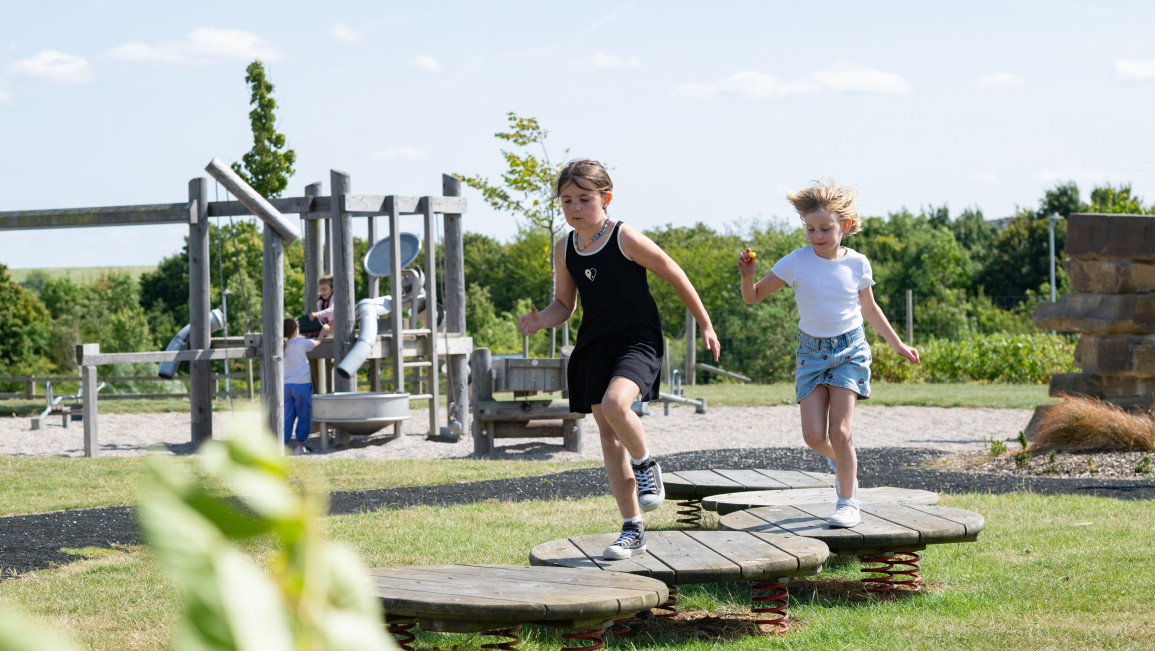
Across the development, Timberplay has created eleven play spaces, each responding to its surrounding landscape while forming part of a wider network of green spaces that encourage movement, exploration and everyday encounters.
Rather than creating isolated playgrounds, the ambition has always been to create places where play feels like a natural extension of the landscape.
Scott describes this as allowing play to "bleed into the surrounding landscape", using landform, planting and natural transitions to remove hard boundaries and encourage exploration.
That thinking is perhaps best illustrated by the award-winning Village Green, a space designed not simply as a playground, but as the social heart of the neighbourhood.
As Scott explains:
"The Village Green had to be the heart of the place. It had to serve every generation because of the nature of where it's located."
It's an approach that reflects a broader philosophy shared by both organisations: successful communities aren't created through individual spaces, but through the way those spaces connect, encourage movement and become part of everyday life.

Collaboration Creates Better Places
Shared values may have brought Timberplay and Urban & Civic together, but it's collaboration that has allowed the partnership to grow.
Over almost a decade of working together, conversations have become more open, ideas have been challenged constructively and every project has informed the next.
For Scott, one of the greatest strengths of the relationship is the ease with which the two teams work together.
"It's fantastic to be able to pick up the phone to pretty much anybody in the team and have a conversation on any one of our play areas, or any one of our future play areas. When you have that readily available, it's such a good tool for positive collaboration."
That openness has helped refine everything from how play integrates with landscape to the way planting, circulation and natural boundaries are approached.
Charlie sees each project as another opportunity to learn.
Every challenge has led to new solutions, with those lessons carried forward into future developments. Rather than applying a standard formula, both organisations continue to adapt their thinking to different landscapes, communities and opportunities.
It's this shared learning that has allowed the partnership to evolve beyond individual projects into a genuinely collaborative way of working.
Success Is Measured by Communities
The success of a play space isn't judged when installation finishes, but much further down the line.
Are families still using it? Do children choose to spend time there? Has it become part of everyday community life?
For Urban & Civic, those are the measures that matter.
Some of their developments have become destinations in their own right, with visitors travelling specifically to experience the quality of the play environments. While that brings its own challenges, it's also evidence that investing in thoughtful, landscape-led play creates places where people genuinely want to spend time.
As Scott explains:
"We're not just trying to target a single function. We want spaces that people want to be in, where they want to dwell, and where communities can grow."
Those spaces don't just benefit children, they encourage families to spend time outdoors, create opportunities for neighbours to meet and help establish the social fabric that turns housing developments into thriving communities.
A Partnership That Continues to Grow
The relationship between Timberplay and Urban & Civic has never been about repeating the same solution.
Each new project brings different landscapes, different communities and different opportunities. The lessons from Corby have informed work at Wintringham, while continued collaboration at Waterbeach and Alconbury Weald builds on nearly a decade of shared experience, adapting that learning to new places and new contexts.
Ultimately, the success of the partnership isn't measured by the number of projects delivered or the awards they've received, but by the communities who use the play spaces.
As Scott Chalmers puts it:
"Ultimately, I want every play area to be busy, active and still in use in years to come."
It's a simple ambition, but one that has shaped almost a decade of collaboration between Urban & Civic and Timberplay.
As both organisations continue to shape new communities across the UK, that ambition remains unchanged: not simply designing playgrounds, but designing communities where play is embedded within the landscape and everyday life.
Play Attention Podcast
To hear more about the ways Scott Chalmers has integrated play into the very fabric of design at Urban & Civic, listen to his conversation over on the podcast.
Play Attention: Ep 6: Play Isn't a Place. It's the Whole Plan.